the end of the tomatoes, with bread
October 1st, 2007

We’ve had a bit of a cold snap around these parts. A little autumnal chill that hints at the jacket weather to come. The kind of weather that begs for closing up windows and putting on warm socks.
Of course, yesterday it was too warm for long sleeves, and even though there was apple pie and roasted squash, it was clear that fall has only been teasing us and has yet to be reliably here.
In the midst of this fitful seasonal hot and cold, there are still odds and ends of summer to use up. And this is something you need to know how to make if you have a few odd tomatoes lying around waiting to be put to good use.
It’s so easy it’s hardly even a recipe. It was invented by those thrifty Tuscans who were always looking for ways to use up old bread (their saltless pane Toscano seems to have left them with an overabundant supply of the stuff).
Panzanella is the sort of dish everyone should have in their back pockets, ready to pull out and assemble in hungry moments. It sounds too simple to be so incredibly delicious. But it isn’t. Really.
It’s another take on the familiar combination of tomatoes and starch so popular in spaghetti and pizza and bruschetta, and it can hold its own against any of them. When I made it for the first time about a year ago, I couldn’t believe I hadn’t been eating it forever. Just crusty bread, tomatoes, olive oil, balsamic vinegar, and basil. And some good salt and a few cracks of black pepper. And you have a dinner to devour. Really.
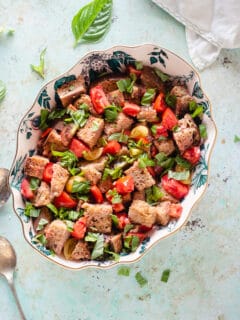
Panzanella, or Tuscan Tomato Bread Salad
This is a dish with so many variations. Some versions add slices of cucumbers or onions or olives, some use red wine vinegar instead of the balsamic I use here. The traditional method seems to be to soak pieces of day-old bread in water, but I prefer the depth of flavor and complex texture that toasted bread brings to the dish, especially since I usually make this with fresh bread that needs to be a little dried out to soak up the oil and vinegar and tomato juices. If I’m feeling decadent, I sometimes add some fresh mozzarella. Feel free to experiment, but do use a good artisan loaf of bread and the best tomatoes you can find. I’ve given rough amounts here for one person for a main dish, multiply as you see fit.
1 medium tomato per person, sliced into bite-sized pieces
2-3 thick slices of crusty bread, cut into rough 1-2 inch cubes
1 clove of garlic, peeled and smashed with the flat side of a knife
1 teaspoon balsamic vinegar
3 teaspoons good quality extra virgin olive oil (plus an optional smidge of any old olive oil)
a few big leaves of fresh basil
kosher or sea salt
freshly cracked black pepper
In a heavy-bottomed skillet over medium heat add a smidgen of olive oil (optional) and add the garlic clove and the bread cubes and toast until the bread gets golden on a few sides. Stir and toss the bread cubes and garlic occasionally and watch to be careful that they don’t burn. This should only take a few minutes. Add the bread and garlic to a medium bowl. Add the tomatoes and the olive oil and balsamic vinegar. Tear up the basil and add it to the bowl. Add a pinch of salt and a few good cracks of black pepper. Give everything a stir and let it sit for about 10-15 minutes. Give it a stir again. (You can pull out the garlic clove if you like. Its flavor should have rubbed off on everything.) And eat–either straight from the bowl or on a plate if you can wait that long.
Yields one main course serving. (Easily multiplied.)
beets and blues
September 4th, 2007
I don’t do well in the heat. On days when the mercury pushes 90 degrees F I wilt. I can go for weeks without cooking anything substantial. I drink big glasses of lemonade mixed with iced tea. I stick my head in the freezer in search of some refreshing sorbet. I sip on gins and tonics with generous slices of lime. I survive on simple sandwiches, on tortillas smeared with pinto bean dip sprinkled with cheese and warmed in the toaster oven, on bags of prewashed sugar snap peas and baby carrots. If I’m feeling fancy, I might snag a nice hunk of multi grain baguette topped with a slice of tomato with a drizzle of good olive oil and a pinch of sea salt, but I’m usually too heat addled to even think of something that sophisticated.
It is nice then, to find a few days of reprieve, when turning on the oven doesn’t sound like punishment and when I can roast some beets and bake some polenta and sit down to a dinner that feels worth eating at the table, slowly, with pleasure.
It is only in the last few years that I have learned to appreciate beets. They have such a pleasing density, such an unusual intensity of hue. I find that their earthy sweetness plays well with bright citrus flavors as well as with pungent and creamy cheeses like the gorgonzola in this salad.
It takes just enough time and effort to make it feel like you went to some trouble, but not enough to overwhelm you. Just enough to convince you that it might be time to make friends with the kitchen again.
Roasted Beet and Gorgonzola Salad
With its deep red beets and striated blue cheese set against a bed of greens, this salad is a stunner. It can withstand all sorts of modifications. Use any greens you like or have on hand. I used a mix of baby greens, but spinach or escarole or arugula or a crisp leaf lettuce would be fine. If caramelizing the onions and mushrooms feels like too much, leave them out or toss on some green onion or some fresh herbs at the end instead.
1 bunch beets (about 4 medium)
1/4 cup gorgonzola cheese, crumbled
1/2 small onion, sliced
a small handful of mushrooms, sliced
3 tablespoons pine nuts, toasted
a big handful of greens, washed
balsamic vinegar
good extra virgin olive oil
sea salt
black pepper
Preheat oven to 375 degrees F. Wash the beets and trim off the stem and root ends. Rub the beets with olive oil, wrap in aluminum foil, and roast until they give a little when squeezed or prodded with a fork, about 45 minutes.
Meanwhile, in a heavy bottomed skillet over medium-low heat, saute onions and mushrooms in a little olive oil until the onions are caramelized and the mushrooms are deep brown, about 20 minutes. You don’t have to stand over these, just check on them every five minutes or so to make sure they aren’t burning and to give them a little stir. Set aside.
When the beets are done roasting, rinse them under cool water and slip off the skins. If the skins are stubborn, remove them with a peeler or a paring knife, but be careful–those beets are still really warm inside. Cut the beets into thick slices.
Pile the greens on a plate and drizzle with olive oil and balsamic vinegar (toss with your hands to give the leaves a light all-over coating). Add the caramelized onions and mushrooms and slice beets. Sprinkle with pine nuts and gorgonzola. Add another drizzle of olive oil and vinegar and a pinch of sea salt. Eat.
Yields two light main course servings or four side servings.
with the grain
March 8th, 2007
Dan raised a quizzical eyebrow when he heard me say “barley salad.”
It’s tough to make barley sound sexy. It tends to sneak into our diets unnoticed, flavoring our beers and bagels and scotch whiskies and malted milk balls, lingering in the background but seldom taking center stage.
Basho, the seventeenth century Japanese master of haiku, mentioned the grain in one of his more famous poems:
Girl cat, so
thin on love
and barley.
Basho had a knack for locating images imbued with sabi, a quality referring to something aged, solitary, tranquil with the beauty of a “rustic patina.”1 Barley has that rustic patina in spades.
There is something so satisfying about this. Hulled barley’s earthy flavor and pleasantly chewy texture pair well with rich caramelized cauliflower and garlicky, juicy roasted mushrooms. Shaved fennel adds crunch and a smattering of watercress mixes a lively green with the whites, beiges, and browns.
Hearty but not heavy, this is a salad for late winter. It’s a bowl and fork kind of meal. It’s good warm, but works equally well cold. It travels well and keeps well, making it an excellent brown-bag lunch, if it sticks around that long. (And, as it turns out, Dan likes it.)
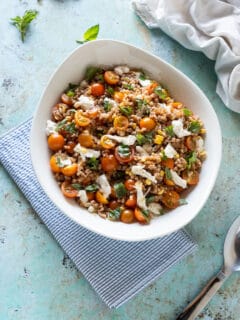
Lemony Barley Salad with Caramelized Cauliflower, Roasted Mushrooms, and Shaved Fennel
This salad requires about an hour and a half of lead time, but the time-consuming parts can be done in advance. Hulled barley takes an hour to cook and can be prepared a day ahead of time (pearl barley, a more refined, quicker-cooking version can be substituted; it will provide a milder flavor and softer texture). I baked the barley, using a method of Alton Brown’s. It can also be boiled, which would free up the oven for roasting the vegetables. You could easily substitute another green for the watercress–arugula and spinach come to mind.
2 1/2 cups cooked hulled barley (baked, or boiled) and cooled to room temperature
1/2 head cauliflower, sliced about 1/4 inch thick and separated, roughly, into florets
4 ounces button mushrooms, quartered
1/2 medium yellow onion, quartered (the half should be quartered, making the slices eighths, I suppose)
1/2 medium fennel bulb, trimmed and sliced very thin
a few sprigs of watercress, washed and trimmed
1 clove garlic, minced
1/4 cup freshly grated parmesan cheese
1 lemon
1/4 cup olive oil
salt, pepper
Preheat oven to 400°F.
In a large bowl, toss cauliflower and mushrooms and onion slices with about a tablespoon of olive oil. Spread on a sheet pan and season with salt and pepper. Sprinkle minced garlic over the mushrooms, turning to get some on all sides. Roast, turning everything over after 15 minutes, until cauliflower and onions are caramelized and mushrooms are a deep brown, about 25-30 minutes.
Toss barley, cauliflower, mushrooms, onions, and fennel with 3 tablespoons of olive oil and the juice of one lemon. Garnish with watercress, salt and pepper, and grated parmesan.
Yields 4 main-course servings.
- Parkes, Graham, “Japanese Aesthetics”, The Stanford Encyclopedia of Philosophy (Spring 2006 Edition), Edward N. Zalta (ed.), http://plato.stanford.edu/archives/spr2006/entries/japanese-aesthetics. [back]
mean greens
February 25th, 2007
I’ve never really found my salad groove. I like salads well enough. I have the best of intentions. I dutifully buy greens, but I seldom have a clear plan of how I’ll use them. They tend to sit in the bottom of the vegetable drawer in the refrigerator waiting for me to find some inspiration, which tends not to arrive until the greens are well past their crisp prime and have become a limp and all-too-slimy shadow of their former selves.
But that’s all going to change. I resolved to get better at salads this year, and one of my early coups involves that peppery green sitting clomplacently at the the tail end of the alphabet, the watercress.
This is a green for the ages. “Eat cress and gain wit,” an ancient Greek proverb counsels. Watercress doesn’t require a fancy treatment. It’s lovely with just a squeeze of lemon juice, a drizzle of olive oil, and a sprinkling of sea salt and freshly cracked black pepper.
It’s also quite pleasant, and quite pretty, when studded with radishes for crunch and color and avocado for a creamy contrast. It made a nice light dinner, but it would certainly do well as first course or an accompaniment, if that’s how you prefer to salad.
Watercress, Radish, and Avocado Salad
The contrast of textures and flavors makes this salad sing, but it could work well with any number of additions or substitutions. Pink grapefruit, cilantro, mint, basil or a tangy crumbly cheese would all be welcome on this plate.
1 big handfull of watercress, rinsed with thicker stems removed (note: the thinner stems are perfectly edible)
2 radishes, thinly sliced
1/2 ripe avocado, sliced into strips about 1/4 inch thick
2 teaspoons extra-virgin olive oil
1 teaspoon freshly squeeze lemon juice
1/8 teaspon sea salt, such as Maldon, or fleur de sel
freshly ground pepper
Arrange watercress on a plate, dot with radishes and avocado, drizzle with lemon juice and olive oil, sprinkle with sea salt and pepper. Eat.
Serves one as a light dinner or two as an appetizer or side