September 2010

You are currently browsing the monthly archive for September 2010.

I love peaches.

The summer after I graduated from college, I worked at a farmers market fruit stand, and after crawling out of bed bleary-eyed at 5:00 am on Saturday mornings and taking the bus up to a parking lot where I’d unload a truck and set up tables and a tent and load little baskets and set up signs, before the customers showed up, I’d rummage around in the crate of bruised peaches for a soft, dented, ugly, unsellable specimen and take a bite, letting the sticky juice drip down my arm.

It was, pretty much, the best breakfast ever.

Before that summer, I never knew that peaches are best when they are warm. That they are so much more fragrant and their flavor so much more complex after resting for a while in the back of a hot truck. That having a job where you can wipe off your sticky arm on your grubby jeans and have the option of getting paid in peaches is a pretty nice gig.

But I no longer have that job or those jeans. And peaches are a summer fruit, and we have already stepped into fall. And out of season peaches, when you find them, tend to be crunchy and tasteless, barely resembling the peaches I love.

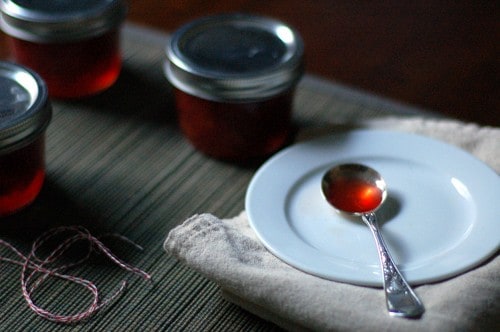
So these preserves are my best attempt to bottle that fragrant sticky sweetness and put it up on the shelf within easy reach for toast.

Those ugly dented fruits are just fine in preserves, but if you have some slightly underripe ones they’ll work well too. When you add sugar, it doesn’t matter so much if they aren’t perfectly sweet, and the less ripe fruits have more natural pectin to help thicken things up.

I add no pectin here. But I do let the fruit macerate in sugar over night and then simmer them with a vanilla bean and a splash of elderflower liqueur.  It’s a loose style of preserves, with noticeable pieces of fruit remaining. If you prefer a thicker, more uniform jam, you can mash the fruit and cook it longer. It is also plenty sweet. If you intend to pair it with dessert in, say, brown butter peach bars, you might want to cut down on the sugar.

Peach Elderflower Vanilla Bean Preserves

Source: adapted from Russ Parsons in The Los Angeles Times

These preserves should be started at least eight hours before you want to make them, so I recommend prepping the fruit and allowing it to macerate overnight. You could, however, do it all in one day if you get an early start. They have a soft set, so don’t expect them to be as stiff and thick as commercial varieties. If you like things less sweet, you could reduce the sugar by anywhere from a half cup to a cup and cook them longer. The less sugar you use, the softer the set is likely to be. You can store these in the refrigerator for several weeks, or you can process them in a water bath (here are some guidelines) and store at room temperature for up to a year.

2 pounds of pitted, diced peaches
3 3/4 cups sugar
1 vanilla bean
1/4 cup St. Germain elderflower liqueur
juice of one lemon (about 2 tablespoons)

In a large nonreactive sauce pan, add peaches and sugar and cook over medium heat until the sugar is dissolved. Remove from heat, stir in the lemon juice. Transfer to a bowl (or other refrigerator friendly container), cover, and refrigerate overnight or for at least eight hours.

Wash canning jars in hot soapy water (or sterilize them in boiling water) and have them ready. Put a small plate into the freezer (this is for testing the set of the preserves).

Return the preserves to a heavy bottomed nonreactive sauce pan, slice the vanilla bean in half the long way and scrape out the seeds into the pan and add the scraped vanilla bean to the pan as well. Add the St. Germain and stir. Cook over medium-high heat, stirring constantly, until the preserves thicken, about 10 minutes. To test, drizzle a bit on the chilled plate. Allow it to cool for a minute, then run your finger through it. If the jam feels gel-like and holds the line, it’s ready to go. If it drips back into the middle, cook it for a few minutes longer and test again. When set, remove from heat and ladle into jars. Store in the refrigerator or process in a water bath.

Yield: about 5 cups

  • Share/Bookmark

September is back.

And I find, still, that I miss school. I miss the stuff of it. It’s been too many years since I’ve bought school supplies. No crisp clean notebooks, no colored pencils, no folders, no protractors, no scientific calculators. No Trapper Keepers. There is hardly any Velcro in my life. I miss the smell of crayons and loose leaf, I miss the sound of cutting construction paper and the tactile satisfaction that comes with peeling the dried translucent coating off the top of last year’s bottle of glue.

I miss the feeling that I was about to embark on a new grand adventure and the feeling that this, oh, this would be my year.

Without the thrum of pencils scratching paper, the rustle of syllabi replete with goals and assignments and grading scales explaining in comprehensive detail what I need to do to be successful, I feel unmoored this time of year.

We always talk about new beginnings in January, about green shoots and renewal and cleaning in spring, but I feel freshest and most energized in early fall. (I wonder if I should have been born Jewish, with a calendar that sensibly locates the new year around this time…)

The older I get, the more value I find in simple concrete achievements. I come home after a day of work, during which I have not changed the world, have not fixed anything in a tangible way even if I have smoothed wrinkles, updated information, stetted and accepted copyedits, and pored over tables of statistics and tried to make sense of another corner of the planet. I find myself wanting to hold something and feel the satisfaction that comes with being able to stare at a finished work and say “I made this.”

So. Here is a tart. I made it. It was good.

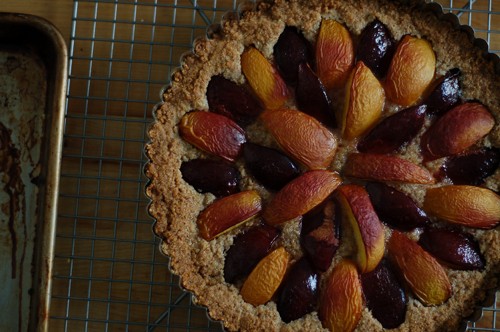
Very good, in fact. My gold star for September. My small new achievement. My plum nectarine almond tart.

I love plums in baked goods. They turn jammy and retain a hint of sour, like rhubarb or tart cherries do in spring and early summer, and like cranberries in late fall and winter (and any of those fruits, I think, would make good friends with this crust).  I think of plums as a transitional fruit. They are harbingers of apples and pears, and if we are lucky quinces,  though they sit next to the last of the peaches and their smooth skinned brethren, nectarines.

Plums and nectarines look pretty together, no?

Purples and deep reds and oranges with yellows peeking through. Nectarines are bit tarter than peaches, making them a nice companion to plums and a pleasing foil to this sweet almond crust.

This tart is so lovely to look at. The payoff here for the amount of work is simply fantastic. This dessert is company-ready, but it is so much easier than pie. Really, it’s as easy as crumble.

Whirl almond meal and flour and sugar and butter and baking powder in the food processor and press into a (well! greased!, ahem) tart pan with a removable bottom. Press alternating slices of plums and nectarines in concentric circles, and bake until the edges are a deep golden brown.

The outside gets crunchy like mandelbrot (or like biscotti, but not as hard), while the inside stays soft and rich and creamy very much like frangipane studded with tender nuggets of baked fruit.

This one is going into regular rotation.

Plum Nectarine Almond Tart

Adapted from Alice Medrich’s Pure Dessert

This rich nutty tart is incredibly easy to make. The crust is quite sweet, so look for plums and nectarines that are tart to balance the flavor. You can make this entirely with plums, as Alice does, or you could make it entirely with nectarines. I wouldn’t substitute peaches here, as they would be too sweet and the skins unpleasantly fuzzy. I do think this would be lovely with rhubarb, tart cherries, or cranberries in other seasons though. Also, please note that this tart has far less butter than most, which means that you really need to grease the tart pan (I forgot to do this, and was forced to chisel the pieces from the pan, which wasn’t quite the most elegant way to serve it…).

1/2 cup (2.5 ounces) almond meal
3/4 cup sugar
1/2 teaspoon kosher salt
1/2 cup all purpose flour
1/4 cup whole wheat pastry flour
1/2 teaspoon baking powder
1 egg
3 tablespoons cold unsalted btter
4 small plums
3 medium nectarines

Preheat oven to 375°F. Grease a 9 1/2 inch tart pan (with removable bottom) with butter or spray oil.

In a food processor, combine almond meal, sugar, flour, baking powder, and salt and pulse until well mixed. Cut the butter into several pieces, add to the food processor, and pulse a few times until the butter pieces are pea-sized. Add the egg, and pulse until the mixture is thoroughly moistened and has begun to clump together.

Press the almond mixture into the greased tart pan evenly along the bottom (but not up the sides).

Cut the plums into quarters and the nectarines into sixths. Press the fruit skin side up, alternating plums and nectarines, into the crust in concentric circles, leaving a half inch border around the edge of the pan (this will puff up and become the side crust). You may have a few slices of nectarine left over.

Set tart pan on a baking sheet, and bake for 45-50 minutes, or until the edges are deep golden brown and the almond mixture peeking out around the fruit in the center looks puffed.

Cool on a rack for about 10 minutes, then carefully loosen the rim of the pan. Allow to cool fully. Serve at room temperature.

Yield: About 8 slices.

  • Share/Bookmark

There’s something about this meal that is just so honest.

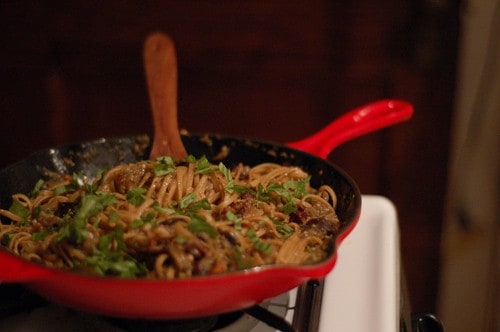
It isn’t flashy. Or even particularly pretty. It is eggplant, slumped and simmered. Simple.

Weeknights beg for meals like this. For things you can set on the stove while you relax and open a bottle of not-too-expensive red wine while you pad around the apartment in bare feet. A meal that relaxes into itself, like a comfy old t-shirt. It isn’t the sort of thing you put on for company, but it is the sort of thing you keep around for when you are tired and don’t want to think about it anymore.

Eggplant isn’t always easy. It can be bitter and seedy and stringy. I get why people don’t like it. It isn’t always my favorite either. But this is a sauce that plays to the strengths of the unassuming aubergine. Chunks of eggplant melt down in the pan absorbing the flavors of garlic and red pepper flakes and thyme. Bits of sun dried tomato punctuate the mellow sauce with intense pops of flavor, and a chiffonade of fresh basil enlivens the gray with dots of bright green.

Tossed with whole wheat linguine, the sauce feels sturdy and nourishing, comfortable and relaxed. Complete unto itself, it doesn’t even need a grating of parmigiano. It holds up well for a few days in the refrigerator, and makes a respectable work lunch to boot.

For the record, I should add that Dan wasn’t crazy about this. He said it wasn’t bad but it wasn’t really his thing either, so perhaps this won’t win over every eggplant skeptic. Oh well, more for me I guess.

Simple Eggplant Linguine

Source: Adapted from Francis Lam on Gourmet.com

The best eggplants tend to be the freshest eggplants, so if you can get them at the farmers market or a store with high turnover you can improve your odds of avoiding bitter ones. I tend to have better luck with smaller eggplants than larger ones. If you do end up with bitter eggplants, you can toss in a little sugar or honey or an extra glug of olive oil to round out the flavor. This dish takes about thirty minutes from start to finish, which makes it a great weeknight meal.

1 pound eggplant cut into half-inch chunks
1/4 cup extra virgin olive oil
3 garlic cloves, peeled and lightly smashed
1/2 teaspoon dried thyme
1/4 teaspoon red pepper flakes
4-6 sun dried tomatoes (not the oil packed variety)
small handful fresh basil
1 cup water
salt
8 ounces whole wheat linguine (any other long pasta is fine)

Soak your sun dried tomatoes in a cup of water for about 10 minutes or until soft and pliable. Drain the tomatoes over a small bowl to reserve the liquid. Dice the tomatoes and set aside. Salt your eggplant and let it sit for about 5 minutes. Meanwhile, put a large saute pan on the stove over medium-low heat and add the olive oil, garlic, thyme and red pepper flakes.

When the garlic is fragrant and starting to show a hint of color, add the eggplant and turn up the heat to medium. After a few minutes, when the eggplant begins to turn translucent, add the reserved water from the sun dried tomatoes. Bring to a boil, then turn the heat down so the water is simmering, and cover, but leave an opening for steam to escape. Let the eggplant cook for about 20 minutes, until soft, stirring occasionally.

Put a big pot of water onto boil for pasta.

When most of the water is absorbed and the eggplant is soft, mash it together with a fork or a wooden spoon until no big chunks remain. Add the sun dried tomates and stir.

Cook and drain your pasta, and add it to the sauce. Chiffonade the basil and add it to the pasta.

Serve immediately.

Yield: About 4 servings.

  • Share/Bookmark