
April 2007

You are currently browsing the monthly archive for April 2007.

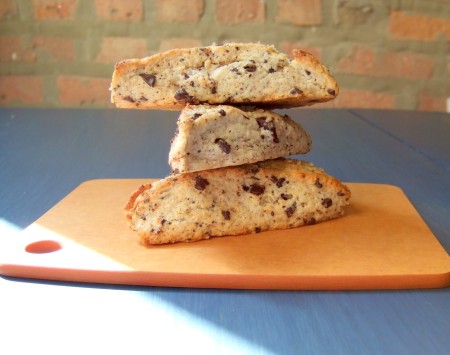
scones_stack

Sometime early in our relationship, when we had been dating for perhaps several months, Dan and I started making scones. It was an almost weekly occurrence, a satisfying project that could be completed in under an hour, proof that we had done something productive in the course of an otherwise relentlessly lazy weekend.

I no longer remember how we settled into scones. I imagine it had something to do with their sturdy, homey appeal, which makes them so comforting to nibble on combined with their faint air of Britishness1, which lends them a certain cosmopolitan stature and makes them seem somehow less pedestrian than a muffin. Or maybe it was just their undeniable deliciousness.

We tried different recipes, added blueberries or raspberries or cinnamon chips, played with amounts of butter and fat content of milk and ratios of whole wheat pastry to all purpose flour. We ate our share of scones. My sister and our roommate even joked that Dan and I should open a bakery selling scones (and pizza, our other staple at the time).

After a while, for no particular reason, we drifted out of making them. We branched out into other baked goods and found ourselves with busier weekends when we sometimes baked nothing at all.

But we recently revisited the habit with a new recipe and were reminded why scones were so easy to fall for in the first place. This recipe is another one from Alice Medrich’s Bittersweet. Made with cream and no butter, these scones are rich, yet light, and crumble when bitten into. The dough is noticeably less sticky than other scone doughs I’ve worked with, and it comes together easily. Out of the oven, these scones are golden on the edges but otherwise a delicate pale speckled with dark bits of chocolate. I think they’re even better on the second day, when their lightness gives way to a pleasing density. I think I could get used to having scones around again.

blossomtostem_unbaked_scones

Cream Scones with Bittersweet Chocolate Chunks

Source: slightly adapted from Alice Medrich’s Bittersweet

These scones are quite delicate and not too sweet. Any type of chocolate works here, and chocolate chips would be fine, but I prefer the texture of uneven bits of melting bittersweet. These are probably too delicate to stand up to any fresh or frozen fruit, but I have a hunch that dried fruits, such as currants, tart cherries, or apricot pieces would be lovely in lieu of chocolate. Cinnamon chips or other flavored chips could also work, if you aren’t in the mood for chocolate. With more than a cup of cream, they are not exactly health food, but they’re worth the splurge for a treat. A coarse sugar, such as turbinado or demerara will be prettier on the tops, but any mildly flavored sugar, including plain refined white table sugar, will do. You can replace a half cup of the all-purpose flour with whole wheat pastry flour, white whole wheat flour or regular whole wheat flour for a slightly heartier, but still tender and light, scone.

2 cups all-purpose flour
1/4 cup sugar
2 1/2 teaspoons baking powder
1/2 teaspoon salt
1 1/4 cups heavy cream
4 ounces bittersweet chocolate, chopped into small chunks
about 1 tablespoon milk or cream for brushing tops
about 1/2 tablespoon sugar, preferably turbinado, demerara, or coarse raw sugar for sprinkling tops (optional)

Preheat oven to 425°F, and line a baking sheet with parchment paper.

In a large bowl, mix flour, sugar, baking powder and salt until well combined. Stir in chocolate chunks. Add the cream and mix until the dry ingredients are moistened. The dough will seem a little dry, but should hold together when pinched. With your hand, knead the dough in the bowl, gently, until it all comes together in a smooth ball.

Turn the dough out onto a clean counter (or silpat or sheet of parchment paper) and pat into a circle about 8 or 9 inches in diameter and about 3/4 of an inch thick. With a butter knife or bench scraper, cut the dough into 8 wedges. Place the wedges onto the prepared baking sheet. Brush the tops with milk or cream and sprinkle with turbinado (or other) sugar, if using.

Bake for 12-15 minutes, or until the edges and tops have turned golden. Cool on racks.

Yields 8 scones.


  1. Even if a scone in Britain is something closer what Americans call a biscuit. [back]
  • Share/Bookmark

crepe_pan

Questions about the safety of Teflon-coated nonstick cookware come up pretty regularly. It seems that the pans have allegedly caused deaths in birds and flu-like symptoms in humans1. The official word from DuPont, the FDA, and the EPA is that they’re generally considered safe when used within recommended guidelines. That includes not heating an empty pan, generally cooking over low or medium heat (up to 450°F or 500°F depending on the manufacturer) and avoiding using metal or sharp-edged utensils that can scratch the coating.

Seems reasonable, for the most part, though a good sear can depend on high heat and it’d be nice to be able to stick them under the broiler without fearing for the safety of nearby birds. There are plenty of people convinced Teflon will kill you or give you cancer or migraines or something. I’m not in their camp, I’m just not convinced that most nonstick pans work all that well.

I find they have a tendency to get gummy when used with nonstick sprays, and when that happens they can be tougher to get clean than their conventional counterparts. With heavy use their nonstick properties seem to diminish, and they need to be replaced more frequently than conventional cookware.

I’m simply not convinced that they have much of an advantage over alternatives that don’t share their questionable safety record.

Cast iron is one alternative. When cast iron is well-seasoned, it releases food easily and lasts forever. Enamel-coated cast iron allows you to skip seasoning the pan and is nonreactive, so you can cook tomatoes and other acidic foods in them without risking any off flavors or colors. Woks are another option. Often made of cast iron or carbon steel, they also require seasoning and release food with minimal effort. The carbon steel ones are lighter, and obviously excellent for stir-frying and any light sauteing. Round woks can wobble on Western gas stoves and don’t really work on flat electric ranges, but flat bottomed woks sidestep that problem.

I’ve recently discover another option I can add to the list, a blue steel crepe pan.

I would never have thought a crepe pan was worth owning. It seemed like a single-tasker, and I don’t make crepes often enough to warrant owning such a specialized item, but this little pan–only 7 and 7/8 inches (20 centimeters) in diameter–has proved to be a versatile compliment to my other cookware.

It is small, light weight, and easily maneuverable. It works well for crepes, of course, and their American cousin, the pancake. I haven’t quite mastered the art of hoisting and flipping a pancake in the pan with a flick of my wrist, but this pan is light enough that I won’t hurt myself trying.

It has become my go-to pan for eggs. Small omelets, made with two or three eggs, fit perfectly. It is also oven and broiler-safe, making it ideal for individual frittatas that tend to spread thin in a larger pan.

It heats quickly and works well for toasting spices or nuts or sauteing anything in small quantities. Its low sides grant a spatula easy access. It also bears a remarkable resemblance to Indian pans used for making flat breads such as dosas, chapatis, and rotis, all of which I’d like to try my hand at at some point.

It does need to be seasoned–I had good luck following these directions on how to do that. Tradition dictates that it be wiped out with salt rather than washed with soap and water. I’ve washed it gently with a small amount of soap to no ill consequence. It does need to be dried immediately and thoroughly to avoid rust.

At only $15, it’s quite a bargain. I’d highly recommend it to anyone looking for alternatives to Teflon or an affordable, long lasting, little pan with loads of old-world charm.

Mine was made by De Buyer. I found it here.


  1. Tugend, Alina. “SHORTCUTS; Teflon Is Great for Politicians, but Is It Safe for Regular People?” The New York Times. October 14, 2006. [back]
  • Share/Bookmark