March 2007

You are currently browsing the monthly archive for March 2007.

asparagus_spaetzle2_marykasprzak

Lifeless in appearance, sluggish
dazed spring approaches–
William Carlos Williams, “Spring and All”

Spring comes to Chicago in fits and starts. We swing from freezing temperatures to upward of 70-degrees and back again, sometimes within the same day. The sun teases us into thinking we barely need jackets, but the wind off the lake reminds us that we should have brought gloves and heavy sweaters, and the ominous clouds urge us to carry umbrellas.

T.S. Eliot famously called April the cruellest month for wantonly stealing away winter’s comforting covers, and there have been years when I’ve been inclined to agree with his assessment. But this year, on the cusp of April, I find my thinking aligned with another poet, Kenneth Koch, wondering impatiently “When will there be a perfectly ordinary spring day?”

Maybe tomorrow, then again, in this city, maybe not until May, or June, or sometime next year…

This is a dish for a fitful early spring day. Asparagus might be the season’s quintessential vegetable. A good bunch can go a long way toward appeasing my impatience for the other parts of spring. Spaetzle, in contrast, are little bits of starchy comfort. These too often overlooked German dumplings consist only of flour, eggs, and water, and are easy to make. Swathed in a beurre blanc sauce, asparagus and spaetzle welcome the green and ward off the chill of a day that straddles spring and winter. This is simple and delicate and makes a lovely dinner with a basic green salad and a glass of wine.

Asparagus and spaetzle with beurre blanc sauce
Source: Adapted from Deborah Madison’s recipe for Asparagus Ragout in Vegetarian Suppers and Judy Rodgers’s recipe for Martha’s spaetzle in The Zuni Cafe Cookbook.

This is an unconventional riff on a beurre blanc sauce. I’ve exchanged red onions for shallots and reduced the butter in the traditional version. The red onions have a stronger flavor than shallots and add bright pink flecks to the sauce, making the effect rather less subtle than the original. You could certainly use shallots here if you prefer. I’ve jumped the gun a bit with asparagus from California. The local stuff doesn’t seem to be available around me yet, but I couldn’t resist and was rewarded with a bunch that tasted like it should. Out of season asparagus tends to taste flat and have a tough, woody texture, which makes it altogether disappointing. Look for bright green stalks with tightly closed tops for better flavor. The width of the stalks is unimportant to the flavor, but roasting times should be adjusted by a few minutes for particularly thick or thin specimens

For the beurre blanc

2 tablespoons champagne vinegar or white wine vinegar
3 tablespoons dry vermouth or dry white wine
1 tablespoon red onion, minced finely
3 tablespoons cold butter, cut into small pieces

For the spaetzle

2/3 cup all purpose flour
1/3 cup white whole wheat flour
2 eggs
6 tablespoons water
special equipment: Colander with 1/4 inch holes (or a spaetzle maker)

For the rest

about 3/4 pound asparagus, tough ends removed
small handful of button mushrooms, thinly sliced (optional)
olive oil
salt
pepper

Preheat oven to 400°F. Cut asparagus into about 1-inch pieces, toss with a little bit of olive oil and place in a single layer on a baking sheet. Roast for about 10-15 minutes, or until tender.

Meanwhile, make the beurre blanc sauce. In a medium sauce pan, add vinegar, vermouth or wine, and red onion. Bring to a boil, reduced heat to medium-low and simmer until reduced to about 1 tablespoon. Remove from heat and whisk in butter, one piece at a time, until all the butter is added and the sauce is smooth and butter-colored. Set aside. (Check the asparagus, remove from oven and set aside.)

Make the spaetzle. Combine flour, eggs, and water in a medium bowl, and blend with a fork until well combined. In a wide saute pan or stock pot, bring water to a boil, and salt generously. Have a slotted spoon and a plate ready. Over the boiling water, place about a third of the batter into a colander and, with a flexible spatula, press the batter through the holes into the water. Be careful to avoid overcrowding the pot–there should be a little bit of room at the surface for the dumplings to move around. The spaetzle should float in about thirty seconds. (If they stick to the bottom of the pot, loosen them gently with a slotted spoon.) After they float, allow them to cook for about 1 minute. Drain them with a slotted spoon and place them in a single layer on a plate. Repeat with the rest of the batter.

In a saute pan over medium heat, add a thin coating of olive oil or butter, add mushrooms if using and spaetzle and saute until spaetzle are slightly browned and crisp. (You could omit this step, if not using mushrooms, and simply toss asparagus and spaetzle with the sauce.) Remove from heat, add asparagus and beurre blanc and stir. Season with salt and pepper.

Yields 2 servings

  • Share/Bookmark

bagel_closeup2

When I lived in Italy, the one meal that became a repeated source of disappointment was breakfast. Don’t get me wrong, I was entranced by the dainty cups and spoons, the mysterious drink requests (caffe normale con un cubetto di ghiaccio [espresso with one ice cube?]), the sometimes oddly tetrahedral or cylindrical sugar packets, and the seemingly unlimited uses for Nutella, but I wanted more than 30-bleary-eyed-seconds to take it all in. And I wanted to sit down. And maybe have something of substance, senza zucchero?

A typical breakfast in Rome consists of a shot of espresso, perhaps accompanied by a sugary pastry, consumed while standing at a bar in a minute or two. Caffe e cornetto sound lovely, but at the start of my day I like my coffee slowly sippable and my foodstuffs no more than slightly sweet. It turns out that when it comes to breakfast, I have a tough time imitating the Romans.

I decided, about six months into my stay, that what I wanted for breakfast, what I really wanted, was a bagel. A dense, chewy, blistered, fresh, warm, golden brown circle of doughy goodness. Sprinkled with seeds. Or salt.

I’m not sure I had ever even had a bagel that quite lived up to the standards of the mythical bagel that danced in my head. Nonetheless, when the early hours rolled around, I craved it. For weeks.

Perhaps there is a source for bagels in the Eternal City (like there is in the City of Light), but I never stumbled upon it. Truth be told, I didn’t really look. I felt rather sheepish about the whole thing, like some sort of ugly American who felt entitled to every good starch, unable to be satisfied with pizza, gnocchi, polenta, in a land where pasta and potatoes have been immortalized as a respectable meal for good common people in film. So most mornings I tossed back un caffe¨, nibbled on some dry biscotti and looked forward to the meals at which my host country excelled.

Chicago isn’t really known for its bagels. Though it isn’t bagel deprived, it’s certainly no New York or Montreal. But I’ve discovered that I can satisfy any new bagel cravings without putting my shoes on. If only I had had this recipe, some high-gluten flour, and access to a kitchen in Rome…

bagels_overhead1

This recipe comes from Peter Reinhart’s book The Bread Baker’s Apprentice, which has been mentioned elsewhere with high praise. I’ll add my voice to the chorus suggesting you take a look at this book if you are interested in learning more about bread. Reinhart is in the final stages of work on a new book focusing on whole grain breads that I’m looking forward to.

Peter Reinhart’s Bagels

Source: slightly adapted from Peter Reinhart’s The Bread Baker’s Apprentice

The key to the right texture here is high-gluten flour. I had trouble finding it in Chicago, but I was fortunate enough to have some generous benefactors (Dan’s parents) send some my way. It is available online from the King Arthur Flour Baker’s Catalogue. You may also substitute bread flour, according to Reinhart, who cautions that it won’t be quite as chewy. I’ve had good results with barley malt syrup, which is available at most natural foods stores. Reinhart recommends using diastatic malt powder, which is also available from King Arthur Flour. In a pinch, honey or brown sugar will also yield tasty, if not quite characteristically bagel-like, results.

Sponge

1/2 teaspoon (.055 ounce/1.56 grams) instant yeast
2 cups (9 ounces/255 grams) high-gluten flour
1 1/4 cups (10 ounces/295 milliliters) water, at room temperature

Dough

1/4 teaspoon (.028 ounce/.8 gram) instant yeast
1 3/4 cups +2 tablespoons (8.5 ounces/240 grams) high-gluten flour
1 1/4 teaspoons (.3 ounce/8.5 grams) salt
1/2 tablespoon malt syrup, honey, or brown sugar (or 1 teaspoon diastatic malt powder)

Finishing Touches

1 tablespoon baking soda
cornmeal for dusting
optional toppings: sesame seeds, poppy seeds, kosher or sea salt, cinnamon and sugar, etc.

A day (or two) before you want the bagels:

Prepare the Sponge.
In a large bowl (if using a stand mixer, go ahead and start it in that bowl) mix 1/2 teaspoon yeast, 2 cups high-gluten flour, and 1 1/4 cups water until it forms a thick batter. Cover with plastic wrap and let sit until bubbly, nearly doubled in size, and on the verge of collapse, about 2 hours.

Make the Dough.
Add 1/4 teaspoon instant yeast to the sponge and stir. Add the salt, malt syrup or powder, and and 1 1/2 cups flour. If using a stand mixer, stir a few strokes by hand to incorporate some of the dry flour with the sponge (this will help to prevent flour from flying everywhere when you turn on the mixer). Mix on low speed for about 2 minutes, or by hand for a few minutes or until a dough ball has formed. Slowly add the remaining flour, and mix on medium speed for 6 minutes (or knead by hand for about 10 minutes) or until all of the flour is incorporated. The dough should be smooth, stiff, stretchy, and not sticky or tacky. If the dough feels dry and tears easily when stretched, add a little water, a teaspoon at a time, and knead some more. If the dough feels sticky, add some flour.

Divide and Shape the bagels.
Line a sheet pan with parchment paper and spray lightly with oil. Divide dough into 2 3/4 to 3 ounce pieces, or, if you don’t have a scale, into 9 equal pieces. (Reinhart recommends 4 1/2 ounce bagels, which I found to be too large and difficult to work with.) Roll each piece into a ball, place on parchment, cover with a damp towel and let rest for 20 minutes. With your finger or thumb, poke a hole in each piece and stretch to about an inch in diameter. Try to stretch the dough evenly to avoid thick and thin spots. Place on parchment, cover with a damp towel, and let rest for 20 minutes. To test to determine whether the bagels are ready to go into the refrigerator, fill a medium bowl with cool water. Drop one of the bagels into the water. It should float within 30 seconds. If it doesn’t, pat the bagel dry, return to parchment and let rest for another 10 minutes before testing again. If it does float, pat the bagel dry, cover the baking sheet with plastic wrap. Be careful to create an airtight seal, otherwise the bagels could dry out. Place in the refrigerator overnight (or for up to two days).

On the day you want the bagels (one or two days later):

Get everything ready.
Preheat the oven to 500°F. Line a baking sheet with parchment paper and mist with oil and dust with cornmeal. Bring a large pot of water to a boil, and add the baking soda. Have a slotted spoon ready. If you are topping with seeds or salt, have those out and ready. If you are topping with cinnamon and sugar, melt a few tablespoons of butter, and have a cinnamon and sugar mixture ready.

Boil.
Remove the bagels from the refrigerator. Place a few bagels into the boiling water. Be careful not to overcrowd the pot–the bagels will puff up a bit in the water. (I fit about 3 at a time.) Boil for 1 minute, then turn the bagels over and boil for another minute. Place on prepared parchment. (The bagels have a flatter side and a rounder side. Place the flat side down for a more rounded top.) If using seeds or salt, top when the bagels come out of the water. If topping with cinnamon and sugar, wait on that. Repeat with the rest of the bagels.

Bake.
Place baking sheet on the middle rack on the oven and bake for 5 minutes. Reduce heat to 450°F, rotate the baking sheet 180° and bake for an additional 5-8 minutes, or until tops are golden brown. Remove from the oven and cool on racks for about 15 minutes. If topping with cinnamon and sugar, brush tops of bagels with butter just after they come out of the oven and sprinkle with cinnamon and sugar mixture and let cool.

Yields 9 bagels.

  • Share/Bookmark

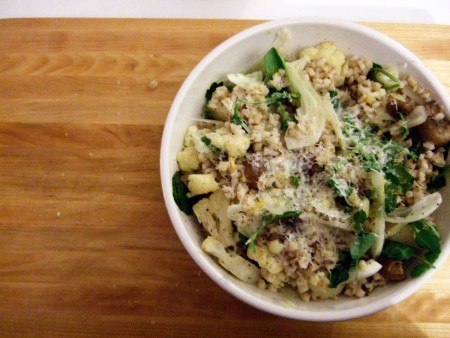
barleysalad_overhead1

Dan raised a quizzical eyebrow when he heard me say “barley salad.”

It’s tough to make barley sound sexy. It tends to sneak into our diets unnoticed, flavoring our beers and bagels and scotch whiskies and malted milk balls, lingering in the background but seldom taking center stage.

Basho, the seventeenth century Japanese master of haiku, mentioned the grain in one of his more famous poems:

Girl cat, so
thin on love
and barley.

Basho had a knack for locating images imbued with sabi, a quality referring to something aged, solitary, tranquil with the beauty of a “rustic patina.”1 Barley has that rustic patina in spades.

There is something so satisfying about this. Hulled barley’s earthy flavor and pleasantly chewy texture pair well with rich caramelized cauliflower and garlicky, juicy roasted mushrooms. Shaved fennel adds crunch and a smattering of watercress mixes a lively green with the whites, beiges, and browns.

Hearty but not heavy, this is a salad for late winter. It’s a bowl and fork kind of meal. It’s good warm, but works equally well cold. It travels well and keeps well, making it an excellent brown-bag lunch, if it sticks around that long. (And, as it turns out, Dan likes it.)

Lemony Barley Salad with Caramelized Cauliflower, Roasted Mushrooms, and Shaved Fennel

This salad requires about an hour and a half of lead time, but the time-consuming parts can be done in advance. Hulled barley takes an hour to cook and can be prepared a day ahead of time (pearl barley, a more refined, quicker-cooking version can be substituted; it will provide a milder flavor and softer texture). I baked the barley, using a method of Alton Brown’s. It can also be boiled, which would free up the oven for roasting the vegetables. You could easily substitute another green for the watercress–arugula and spinach come to mind.

2 1/2 cups cooked hulled barley (baked, or boiled) and cooled to room temperature
1/2 head cauliflower, sliced about 1/4 inch thick and separated, roughly, into florets
4 ounces button mushrooms, quartered
1/2 medium yellow onion, quartered (the half should be quartered, making the slices eighths, I suppose)
1/2 medium fennel bulb, trimmed and sliced very thin
a few sprigs of watercress, washed and trimmed
1 clove garlic, minced
1/4 cup freshly grated parmesan cheese
1 lemon
1/4 cup olive oil
salt, pepper

Preheat oven to 400°F.

In a large bowl, toss cauliflower and mushrooms and onion slices with about a tablespoon of olive oil. Spread on a sheet pan and season with salt and pepper. Sprinkle minced garlic over the mushrooms, turning to get some on all sides. Roast, turning everything over after 15 minutes, until cauliflower and onions are caramelized and mushrooms are a deep brown, about 25-30 minutes.

Toss barley, cauliflower, mushrooms, onions, and fennel with 3 tablespoons of olive oil and the juice of one lemon. Garnish with watercress, salt and pepper, and grated parmesan.

Yields 4 main-course servings.


  1. Parkes, Graham, “Japanese Aesthetics”, The Stanford Encyclopedia of Philosophy (Spring 2006 Edition), Edward N. Zalta (ed.), http://plato.stanford.edu/archives/spr2006/entries/japanese-aesthetics. [back]
  • Share/Bookmark

tahinibread_overhead1

When I mentioned to a few people that I was planning to make Armenian tahini bread, the most common response was, “Where exactly is Armenia?”

This landlocked country in Transcaucasia, bound by Georgia to the north, Azerbaijan to the east, and Iran and Turkey to to the south and west, has had a rough go of it. Outsiders repeatedly mistake and confuse its identity when they remember it at all (Clarissa Dalloway’s muddled refrain regarding “the Albanians, or was it the Armenians?” whose genocide her husband was so concerned about comes to mind). Even the term Armenian was likely a result of a mix-up by the Greeks or the Iranians who mistook them for Aramaeans; Armenians called themselves Hayk. (They are still being misrepresented in popular media, Borat’s “Kazakh”-speaking friend was actually speaking Armenian.)

Still, I’ve found something that will help to fix Armenia in my memory at least. This tahini bread is a traditional food for the Christian season of Lent, which is usually a time for fasting and general self-deprivation, but this is an unusual treat. It dispenses with butter, eggs, and cream in favor of a dough enriched with a bit of olive oil and marbled with sugary, cinnamon-scented sesame paste. When I saw the recipe in the January/February issue of Saveur, I couldn’t get it out of my head.

Saveur describes these as “a croissant mated with halvah.” I approached them thinking cinnamon rolls, but came away thinking of them as a danish’s much heartier, nuttier cousin. They look deceptively bready–but unlike most breads, they crumble. And ooze tahini.

A slice of one of these makes a satisfying breakfast or a good afternoon companion for tea. It can also pass for dessert.

Armenian Tahini Bread

Source: Adapted from the Jan./Feb. 2007 issue of Saveur magazine. Original recipe can be found here.

Shaping these can be tricky. Don’t be alarmed if some of the tahini-sugar mixture oozes out or the dough develops a little hole. Just patch everything up as well as you can and keep going. Their homey, rustic presentation is part of their charm. I used a blend of all-purpose and white whole wheat flour. I thought the mild whole wheat flavor complemented the sesame well. If you want to use regular whole wheat, I’d adjust it to 1 cup and increase the ap flour to 1 1/2 cups to prevent it from getting too heavy. All ap also would also work, if that’s what you have on hand.

1 1/8 teaspoons instant yeast
1 cup sugar
1 1/4 cups all-purpose flour
1 1/4 cups white whole wheat flour
1 1/2 teaspoons ground cinnamon
1 teaspoon salt
1 tablespoon extra-virgin olive oil
1 cups tahini
3/4 cup water, lukewarm

In the bowl of a stand mixer, stir together the flour, yeast, salt, and 1 teaspoon of cinnamon. Add water and olive oil. Mix with the paddle attachment on low speed until it comes together to form a shaggy dough, about 2 minutes. Switch to the dough hook and mix on medium speed for about 6 minutes or until the dough is smooth and elastic. It should clear the sides of the bowl.

Place the dough into a lightly oiled bowl (it can be the same bowl it was mixed in), and turn the dough once to coat with oil. Cover the bowl loosely with plastic wrap and let rise in a warm place until doubled, about 2 hours.

Preheat the oven to 350° F. Turn dough out onto a lightly floured surface and divide into two pieces. Cover with plastic wrap and let rest for about 10-15 minutes. Line two baking sheets with parchment paper and set aside.

Roll out one piece of dough into a long rectangle, about 12-14 inches long and 4-5 inches wide. Spread 1/2 cup tahini over the dough, leaving about 1/4 inch border on all sides. Sprinkle 1/2 cup sugar and 1/4 teaspoon cinnamon over the tahini.

Starting with one of the long sides, roll the dough over itself into a long cylinder. Pinch the dough together along the seam and on the ends to form a seal. Using a bench scraper or serrated knife, cut the cylinder into three equal pieces. Pinch the newly cut ends together to seal in the tahini mixture.

This is where things get messy. Take one piece and roll and stretch it until it is about 7-8 inches long. Starting with the narrow end, carefully roll the dough cylinder into a spiral and, again, pinch the ends together to form a seal. Flatten the dough with your hand and, with a rolling pin, roll it out into a circle that is 7 inches in diameter. Repeat with the other pieces. Transfer to a prepared baking sheet, leaving at least an inch between each dough circle, and bake for 20-25 minutes or until the tops are light brown.

While the first sheet is in the oven, roll out the other piece of dough and repeat the filling and shaping process. Bake as directed above.

Cool on racks. Slice each round into four pieces before serving.

Yields 6 large rounds, for 24 servings. Best consumed within about 2 days. (Can be frozen and revived in the oven for longer keeping.)

  • Share/Bookmark